MUMBAI, INHeadquarters
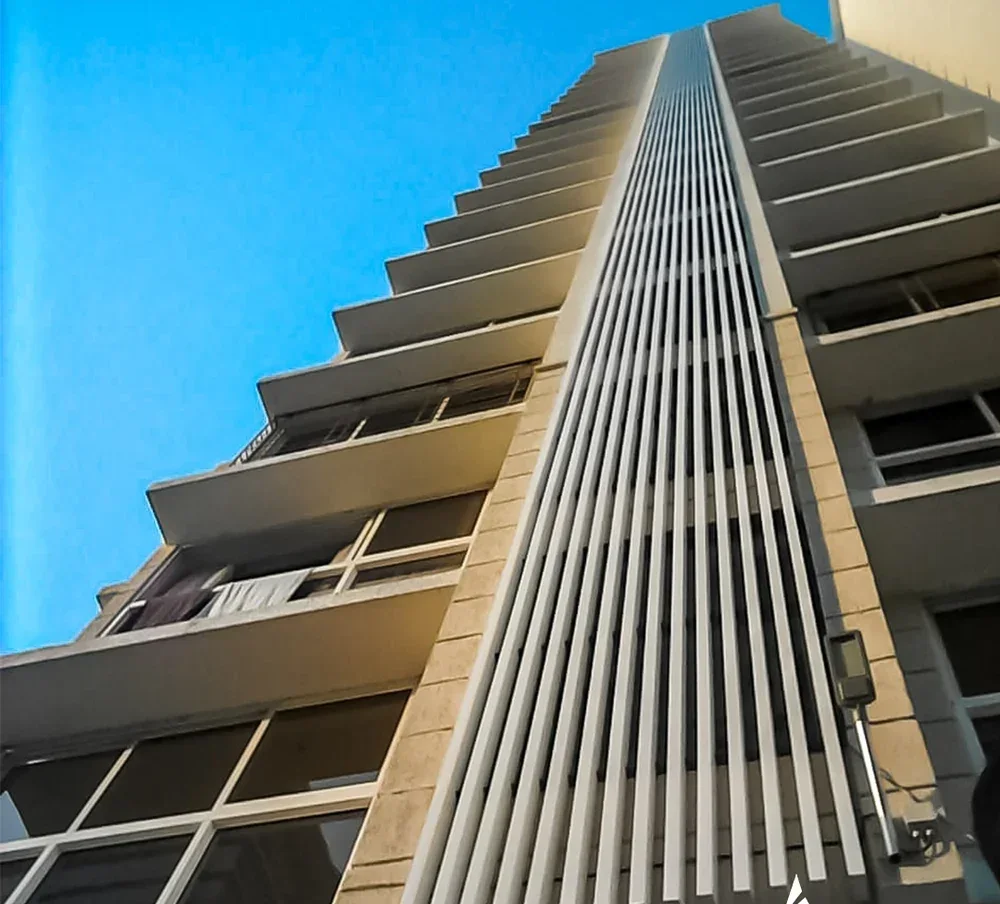
The global facade industry is witnessing a seismic shift. For decades, aluminum was the uncontested king of external louvers. Today, a combination of **thermodynamic necessity**, **corrosion science**, and **life-cycle economics** is driving a massive transition toward **Engineered uPVC Systems.**
To understand the failure of aluminum in tropical climates like India, we must look at the **Stefan-Boltzmann Law**. Aluminum, as a metal, has a thermal conductivity coefficient of approximately **205 W/m·K**. In simpler terms, it is a high-speed thermal bridge.
When an aluminum louver system is exposed to the brutal 40°C afternoon sun of Hyderabad or Chennai, it doesn't just block light; it becomes a secondary radiator. The metal absorbs solar radiation and re-emits it as long-wave thermal energy directly into the building's glazing. This creates a "Heat Pocket" that forces HVAC systems to run at 110% capacity just to maintain a baseline of 24°C.
Avantra's uPVC profiles operate on a completely different thermodynamic principle. With a thermal conductivity of **~0.14 W/m·K**, uPVC is a natural insulator. It decouples the external solar load from the internal thermal envelope.
Our in-house CFD (Computational Fluid Dynamics) simulations show that substituting aluminum with Avantra uPVC can reduce the facade's surface temperature by up to **18°C**. This directly translates to a **4°C to 7°C reduction** in Mean Radiant Temperature (MRT) near the windows, drastically improving occupant comfort without additional power consumption.
.webp&w=1600&q=75)
Case Study: Structural UPVC fins delivering thermal performance on site
In coastal metropolitan belts—specifically Mumbai, Chennai, and Kochi—the atmosphere is classified as **C5-M (Marine High Corrosivity)**. For metals, this is a graveyard. Aluminum, even when treated with high-grade powder coatings, is susceptible to **pitting corrosion** and **filiform oxidation**.
The failure usually begins at the microscopic level. Saline-laden air finds tiny fissures in the coating—often at the edges of the louvers where the coating is thinnest. Once the metal is exposed, the galvanic process begins. The coating starts to bubble, then peel, exposing the structural core to rapid decay.
Engineered uPVC is a polymer—it is chemically incapable of oxidation. It does not rust, it does not pit, and it is completely unaffected by the saline air of the Arabian Sea or the Bay of Bengal.
By utilizing Avantra systems, developers are essentially "future-proofing" their asset. While aluminum systems in Mumbai typically require expensive repainting or structural replacement every 7-10 years, an Avantra uPVC facade is designed for a **35-year service life** with zero structural degradation.
A common misconception in the industry is that uPVC lacks the structural "heft" of metal. This overlooks the engineering of **Internal Galvanized Steel Reinforcement**.
At Avantra, every louver profile is a composite structure. The uPVC skin provides the insulation and aesthetic durability, while a high-tensile, galvanized steel core provides the structural rigidity. This allows our systems to meet and exceed **IS-875 Part 3** requirements for wind loads.
In high-rise applications up to 150 meters, where wind pressures can reach **4.5 kPa**, our fins remain dimensionally stable. Our proprietary "Floating Bracket" mounting system further allows for thermal expansion and contraction without compromising the structural fasteners—a critical failure point in traditional rigid metal mounting.
High-rise living in cities like Bangalore or Mumbai is plagued by urban noise. Aluminum louvers are essentially hollow metal tubes; they amplify wind vibration and reflect street noise.
Avantra's multi-chambered uPVC profiles act as acoustic dampeners. The density of the polymer combined with the internal air-pockets creates a significant sound transmission loss (STL). Projects utilizing our fins report a 12dB reduction in exterior noise ingress compared to aluminum equivalents.
.webp&w=1600&q=75)
Technical Integration: Sound-reducing UPVC louvers for dense urban sites
In modern architectural practice, a product is only as good as its digital representation. Avantra provides full **LOD 400 BIM objects** for our entire louver registry.
This allows design teams to integrate our systems directly into their Revit or ArchiCAD models, facilitating automatic clash detection and precise quantity take-offs. Our technical team also provides custom **Grasshopper scripts** for parametric facades, allowing architects to visualize the shading performance and visual rhythm in real-time.
When evaluating facade materials, looking at the **CAPEX (Initial Cost)** alone is a strategic error. The true metric is the **Total Cost of Ownership (TCO)** over 20 years.
1. **Maintenance**: Aluminum requires periodic professional cleaning and eventual repainting (especially in coastal zones). Cost: ₹300-500 per sqft over 10 years. uPVC requires zero painting. Cost: ₹0. 2. **Energy Savings**: Passive thermal regulation reduces HVAC bills by 15-20% annually. 3. **Replacement**: uPVC outlasts aluminum in saline environments by a factor of 3x.
Our data shows that while the initial investment for engineered uPVC might be comparable to high-grade aluminum, the 20-year TCO of an Avantra system is **42% lower**.
The construction industry is under increasing pressure to reduce embodied carbon. While aluminum production is highly energy-intensive (requiring bauxite mining and high-heat electrolysis), uPVC manufacturing has a significantly lower carbon footprint.
Furthermore, Avantra's commitment to a **Circular Economy** means that our profiles are 100% recyclable. We operate a "Buy-Back" program for post-construction scrap, ensuring that every off-cut from our project sites is returned to the production line, creating a closed-loop system that reduces waste to zero.
The conclusion for the modern Indian developer is clear: The age of default metal thinking is over. As energy prices rise and building regulations tighten, the move to high-performance, non-conductive, and non-corrosive materials is no longer optional—it is a mandatory evolution.
Avantra provides the engineering bridge to this future, delivering facades that are as sustainable as they are striking.
Consult with our expert team to integrate IS-875 wind-load compliance and passive thermal shading into your next project.